Step into the world of modern design, and you’ll inevitably encounter the Alessi Juicy Salif. More than just a kitchen tool, this citrus juicer, designed by the visionary Philippe Starck, has sparked conversations and debates since its debut in 1990. Is it a testament to groundbreaking aesthetics, a functional failure, or perhaps both? We’re about to peel back the layers of this intriguing object, exploring its origins, its controversial performance, and its enduring legacy in the realm of design. Get ready to decide for yourself whether the Juicy Salif deserves its pedestal as an icon or a permanent spot in the “beautiful but useless” category.
The Genesis of an Icon: Philippe Starck’s Vision
The story of the Alessi Juicy Salif begins not in a sterile design studio, but reportedly on a humble pizzeria napkin. During a seaside holiday in Italy, Philippe Starck found inspiration while contemplating a plate of calamari and the squeeze of a lemon. This moment of everyday observation led to a spontaneous sketch that would soon become one of the most recognizable objects in contemporary design. Starck himself famously stated that the Juicy Salif was “not meant to squeeze lemons; it is meant to start conversations.” This sentiment perfectly encapsulates the philosophy behind its creation: to transcend mere utility and provoke thought, emotion, and interaction.
Alessi, the renowned Italian design house, embraced this audacious vision, known for its commitment to blending industrial production with artistic expression. Alberto Alessi believed that a true work of design should evoke feelings, communicate, and even transgress, defining it as “poetic.” The Juicy Salif perfectly embodies this ethos, pushing the boundaries of what a household appliance could be and challenging conventional notions of form and function.
Form as Art: Deconstructing the Juicy Salif’s Aesthetic Appeal
At first glance, the Juicy Salif is undeniably striking. Its elongated, tripod-like legs support a conical, ribbed body that culminates in a sharp point. This “alien-head-styled” or “spider-like” silhouette immediately grabs attention, drawing comparisons to extraterrestrial spacecraft or abstract sculpture. Crafted from mirror-polished aluminum, its sleek, metallic finish further enhances its futuristic and minimalist aesthetic. This captivating form has earned it a permanent place in prestigious institutions such as the Museum of Modern Art (MoMA) in New York, the Metropolitan Museum of Art, and the Victoria and Albert Museum.
Its inclusion in such revered collections underscores its status as a significant piece of modern art. The Juicy Salif isn’t just an object; it’s a statement. It represents a bold departure from traditional kitchen utensil design, prioritizing visual impact and conceptual depth over pragmatic considerations. For many, its sculptural presence transforms a mundane kitchen counter into a gallery space, inviting contemplation and admiration.
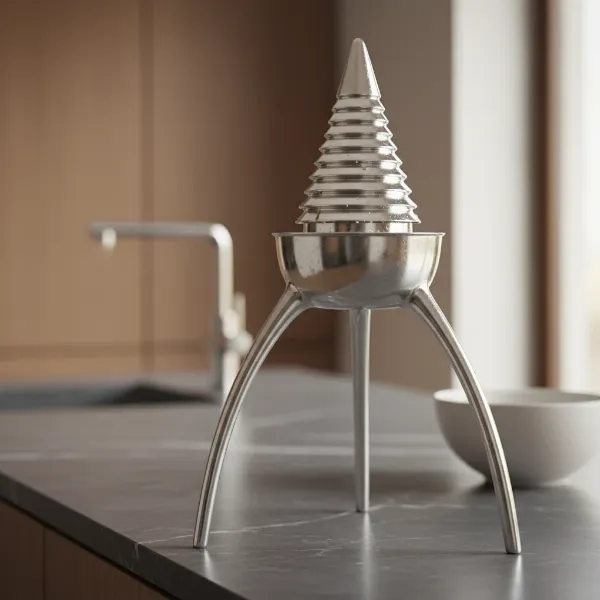 Close-up of the Alessi Juicy Salif, showcasing its unique sculptural design and polished aluminum finish.
The Reality of Juicing: A User Experience Deep Dive
Despite its celebrated form, the Alessi Juicy Salif’s functional performance as a juicer has always been a point of contention. Many users find it to be significantly less effective than conventional juicers, leading to a common criticism: it prioritizes style over substance.
One of the primary complaints revolves around its usability and stability. The three slender legs, while aesthetically unique, often provide minimal traction and can make the juicer unstable during operation. Users frequently report needing two hands to hold it steady, an inconvenient necessity that can also lead to sticky hands.
Furthermore, its efficiency in juice extraction is often questioned. The conical design, while visually appealing, doesn’t always effectively extract the maximum amount of juice from a citrus fruit. Pulp and seeds can easily fall into the glass below, as there is no integrated filter or catchment area, requiring additional straining.
The messiness factor is another frequently cited issue. Without a surrounding basin, juice tends to spray or run down the legs and onto the countertop, making for a less-than-clean juicing experience. This contrasts sharply with the contained process offered by many traditional juicers.
Finally, cleaning the Juicy Salif can be a challenge. Its intricate shape and sharp points can make it awkward to wash thoroughly, and care must be taken to avoid accidental nicks. It is also worth noting that special editions, such as the gold-plated version, are explicitly advised against being used for actual juicing due to the corrosive nature of citrus acid, which can damage the finish.
More Than a Juicer: Its Place in Culture and Home
Given its functional drawbacks, one might wonder why the Alessi Juicy Salif has achieved such widespread recognition and commercial success, selling over a million units since its inception. The answer lies in its ability to transcend its practical purpose and become a cultural phenomenon. As Starck intended, it is first and foremost a “conversation piece.” Placing it on a kitchen counter or dining table is an invitation for guests to comment, question, and engage with its unconventional design.
For designers, architects, and art enthusiasts, the Juicy Salif is a powerful symbol of modern design’s capacity to challenge norms and redefine everyday objects. It represents a philosophical statement about the role of aesthetics in daily life, suggesting that objects can hold value beyond their immediate utility. Owning a Juicy Salif becomes an affirmation of one’s appreciation for innovative design and a willingness to embrace provocative art within the domestic sphere. It is a testament to the idea that a product can be commercially successful not just for what it does, but for what it is and what it represents.
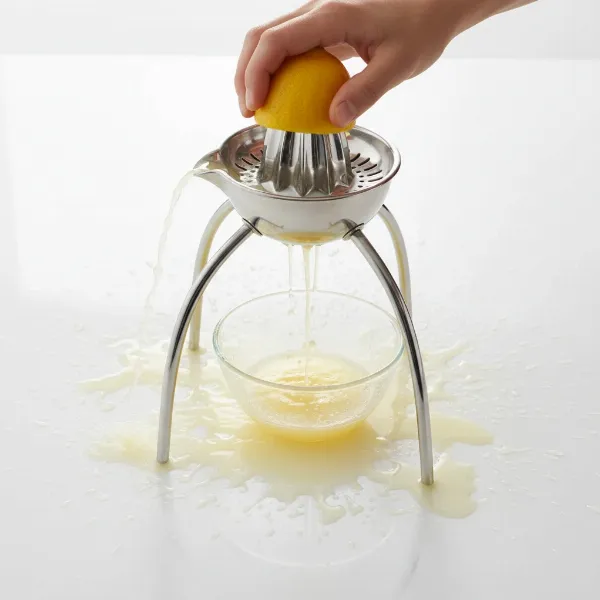 A lemon being juiced on an Alessi Juicy Salif, showing juice dripping onto the counter and hands.
Alessi Juicy Salif: Design Icon or Useless? A Concluding Verdict
So, is the Alessi Juicy Salif a design icon or a useless kitchen gadget? The truth is, it’s profoundly both. As a purely utilitarian device for efficiently extracting citrus juice, it falls short of many conventional alternatives. It can be messy, unstable, and less effective in its primary function. If your sole criterion is maximum juice yield with minimal fuss, then more practical options abound.
However, to judge the Juicy Salif solely on its functional merits is to miss its entire point. It is a masterful example of form over function, a sculptural work of art that happens to resemble a juicer. Its value lies in its aesthetic impact, its ability to provoke thought, and its status as a symbol of audacious, unconventional design. It is a celebration of human creativity and the idea that objects can bring joy and spark dialogue, even if they aren’t perfectly practical. For those who appreciate design as an experience and an expression, the Juicy Salif is undeniably an icon. For others, it might remain a beautiful enigma, occupying prime counter space with little practical purpose. Ultimately, its usefulness is subjective, depending entirely on what you expect from an object in your home.
Frequently Asked Questions
Is the Alessi Juicy Salif actually functional as a juicer?
Table is empty.While it can extract some juice, the Alessi Juicy Salif is generally considered to have significant functional limitations compared to traditional juicers. Many users find it unstable, messy, and less efficient at extracting juice, often leaving seeds and pulp.
Why is the Alessi Juicy Salif so famous?
The Juicy Salif is famous for its revolutionary, sculptural design by Philippe Starck, which challenged conventional kitchenware aesthetics. It’s exhibited in major art museums like MoMA and is celebrated as a significant piece of modern design that prioritizes artistic expression over strict utility.
What was Philippe Starck’s intention behind designing the Juicy Salif?
Philippe Starck reportedly designed the Juicy Salif not primarily as a highly functional juicer, but as a “conversation piece.” His intention was to create an object that would stimulate discussion, provoke thought, and serve as an artistic statement in the home.
Can I use the gold-plated Alessi Juicy Salif to make juice?
No, the special edition gold-plated versions of the Alessi Juicy Salif are explicitly not recommended for juicing. The citric acid from fruits can react with and damage the gold finish, making them purely decorative collector’s items.
What material is the standard Alessi Juicy Salif made from?
The standard Alessi Juicy Salif is made from mirror-polished aluminum casting, which contributes to its sleek, metallic, and modern appearance. This material is durable but can react with highly acidic liquids over time.