A juicer is a workhorse in any healthy kitchen, but constant use can take a toll, especially on its power cord. A frayed power cord isn’t just an unsightly nuisance; it’s a silent hazard lurking in your home, threatening electrical shocks, potential fires, and even damaging your beloved appliance. Understanding when and how to address a damaged cord can extend your juicer’s life and, more importantly, keep your household safe. This comprehensive guide will walk you through the dangers, the critical decision between repair and replacement, and safe, practical steps to fix minor cord issues or replace a damaged plug, all while prioritizing your safety.
The Hidden Dangers of a Frayed Juicer Power Cord
A power cord on your juicer or any appliance experiences a lot of stress. It might get bent, twisted, caught under objects, or even become a chew toy for pets. Over time, this wear and tear can lead to the outer insulation cracking or fraying, exposing the inner wires. This seemingly small issue carries significant risks.
The most immediate danger is electrical shock. Exposed live wires can deliver a painful, and potentially fatal, jolt if touched. Water, a common element in any juicing environment, dramatically increases this risk, turning a minor fray into a life-threatening situation. Beyond personal injury, a frayed cord can also cause electrical fires. Exposed wires can short circuit, overheat, or spark, igniting nearby flammable materials. Furthermore, inconsistent power delivery due to a damaged cord can harm your juicer’s internal components, leading to costly repairs or premature replacement of the appliance itself. Recognizing these dangers is the first step towards a safer kitchen.
Repair or Replace? Making the Safe Choice
When you discover a frayed power cord, the primary question is always: can I fix this, or do I need a new cord or even a new juicer? The answer hinges on the severity of the damage and the type of cord. For your safety, it’s crucial to err on the side of caution.
When to Never Attempt a Repair:
- Exposed Metal Wires: If you can see the copper or other metal conductors, the cord is compromised beyond safe repair.
- Deep Cuts or Nicks: Any damage that penetrates the outer jacket and affects the inner wire insulation is a significant hazard.
- Internal Damage: If the cord feels unusually warm, or if the juicer flickers on and off, there might be internal wire breaks that are impossible to safely repair at home.
- Charred or Melted Insulation: This indicates overheating and a severe electrical hazard; do not use or attempt to repair.
For any significant damage that exposes inner wires or affects the cord’s structural integrity, replacement is almost always the safest and most recommended option. Flexible cords, especially those commonly found on kitchen appliances, are often not designed for splicing, and an improper repair can be a weak point, leading to future failure, shock, or fire. Professional electricians or appliance repair services can assess whether a cord can be safely replaced or if the entire appliance needs attention.
When a Minor Fix Might Be Considered (With Extreme Caution):
Only superficial damage to the outer casing, where no inner wires are exposed and the cord’s flexibility is not significantly altered, might be temporarily addressed. However, even then, this should be seen as a stop-gap measure until a permanent replacement can be made. For peace of mind and long-term safety, replacing the entire cord or the appliance is often the best course of action.
Essential Tools and Materials for Power Cord Repair
Should you decide that a repair is feasible and safe for the type of damage your juicer’s cord has sustained, having the right tools and materials is paramount. Safety begins with preparation.
Here’s what you’ll likely need:
- Safety Glasses and Gloves: Always protect your eyes and hands.
- Wire Cutters: For cleanly snipping through the damaged section of the cord.
- Wire Strippers: Essential for removing the outer jacket and the insulation from individual wires without damaging the conductors.
- Electrical Tape: For minor, superficial insulation repairs only. It’s not a permanent or safe solution for exposed wires.
- Heat Shrink Tubing: This is a superior insulation method for splices. You’ll need various sizes: smaller ones for individual wires and a larger one for the outer jacket.
- Heat Gun or Hair Dryer: To shrink the heat shrink tubing. A lighter can be used with extreme care for small sections, but a heat gun provides more even and controlled heat.
- Soldering Iron and Electrical Solder (Optional but Recommended for Splices): Soldering creates a strong, reliable electrical connection, reducing the risk of loosening over time.
- Multimeter (Optional but Recommended): To test for continuity after the repair, ensuring the electrical connection is sound and there are no shorts.
- Replacement Plug (If repairing near the plug): Ensure it matches the original plug’s rating and type (e.g., polarized or grounded).
- Screwdrivers: Philips and flathead, if you need to open a replacement plug or access an appliance’s internal wiring (though this is typically beyond home repair scope for juicers).
Step-by-Step Guide: Replacing a Damaged Plug
If the damage to your juicer’s power cord is confined to the very end near the plug, replacing the plug itself is a far safer and more straightforward option than splicing the cord mid-length. This method allows you to retain most of your original cord’s length while eliminating the immediate hazard.
- Safety First: Unplug and Disconnect: Absolutely ensure the juicer is completely unplugged from the wall outlet. For extra caution, consider flipping the circuit breaker for that outlet. Never work on a cord that is connected to a power source.
- Cut Off the Old Plug: Using your wire cutters, snip the cord cleanly just behind the damaged area, removing the old plug and any frayed sections.
- Prepare the Cord:
- Carefully use wire strippers to remove about 1 to 1.5 inches of the outer insulation jacket from the end of the cord, exposing the inner insulated wires (typically black, white, and sometimes green/bare copper).
- For each inner wire, strip about 1/2 to 3/4 inch of its insulation, exposing the copper strands. Twist these strands tightly together to prevent fraying.
- Open the New Replacement Plug: Most replacement plugs come in two halves that screw together. Open it up, exposing the screw terminals. Note the color coding: typically, the brass screw is for the “hot” (black) wire, the silver screw for the “neutral” (white) wire, and the green screw for the “ground” (green or bare copper) wire.
- Connect the Wires:
- Thread the prepared cord through the opening of the new plug.
- Loosen the screws on the plug’s terminals.
- Loop the exposed copper strands of each wire clockwise around the corresponding screw terminal. Tighten the screws securely, ensuring no stray copper strands are touching other terminals or are outside the loop.
- Pay close attention to match the wire colors to the correct terminals: Black to brass, White to silver, Green/Bare to green.
- Secure the Plug: Ensure the outer jacket of the cord is firmly held by the plug’s strain relief clamp. This prevents tension on the internal wire connections. Close the plug housing and tighten any screws to secure it.
- Test the Repair: Before plugging it back into the wall, use a multimeter to check for continuity and ensure there are no short circuits. Once confirmed, plug the juicer into an outlet and test its function carefully.
Step-by-Step Guide: Splicing a Frayed Cord (Use with Caution)
Splicing a power cord should be approached with extreme caution and, whenever possible, replacement is preferred, especially for appliance cords. OSHA guidelines, for instance, often restrict splicing of flexible cords smaller than 12-gauge unless specialized kits that restore original cord properties are used. If you proceed with splicing, understand the inherent risks and prioritize a robust, insulated connection. This method is best reserved for situations where cord replacement is impractical and a high level of electrical proficiency is present.
- Safety First: Unplug and Disconnect: Just like with plug replacement, ensure the juicer is unplugged and consider turning off the circuit breaker.
- Cut Out the Damaged Section: Using wire cutters, make two clean cuts to completely remove the frayed or damaged portion of the cord. You will now have two separate ends of the cord.
- Prepare for Staggered Splicing: For enhanced safety, it’s best to stagger the splices of the individual wires. This means the connection points of the black, white, and ground wires should not be directly adjacent to each other.
- From one end of the cut cord, strip about 2-3 inches of the outer jacket.
- From the other end, strip about 3-4 inches of the outer jacket. This will allow for staggered inner wire connections.
- Prepare Individual Wires: For each exposed inner wire, strip about 1/2 to 3/4 inch of insulation from the end. Twist the copper strands tightly.
- Apply Heat Shrink Tubing: This is a crucial step for insulation. Before connecting any wires, slide a larger piece of heat shrink tubing over one of the cord ends – this will be for the final outer jacket protection. Then, slide smaller pieces of heat shrink tubing over each individual wire on one side of the splice. These will insulate the individual connections.
- Connect the Wires: Match colors precisely: black to black, white to white, green/bare to green/bare.
- Twisting: Twist the exposed copper strands of matching wires firmly together.
- Soldering (Recommended): For a secure connection, solder the twisted wires using a soldering iron and electrical solder. Allow the solder to cool completely.
- Wire Nuts (Alternative): If not soldering, use appropriately sized wire nuts to secure the twisted connections. Ensure they are tightened securely.
- Insulate Individual Connections: Slide the smaller pieces of heat shrink tubing over each soldered/wire-nutted connection. Apply heat with a heat gun or hair dryer until the tubing shrinks tightly around the splice, creating a sealed, insulated connection. Ensure the plastic does not melt or burn.
- Insulate Outer Jacket: Arrange the individually insulated wires neatly. Slide the larger piece of heat shrink tubing over the entire spliced section, covering all individual wire connections and extending slightly onto the intact outer jacket on both sides. Apply heat evenly until it shrinks tightly, providing a robust outer seal.
- Test the Repair: Before plugging it in, use a multimeter to verify continuity across the cord and check for any short circuits between wires or to the ground. Once verified, carefully plug the juicer in and test its operation.
“When it comes to electrical repairs, safety isn’t just a recommendation; it’s a non-negotiable principle. Always choose replacement over repair if there’s any doubt about the integrity of a power cord, especially for high-use kitchen appliances like juicers.” – Lan, Admin of CitrusJuicerr.com
Temporary Fixes: The Electrical Tape Dilemma
Many people reach for electrical tape at the first sign of a frayed cord. While electrical tape is designed for insulation, its use as a “fix” for power cords comes with significant caveats and often isn’t recommended as a permanent solution.
For truly superficial damage—meaning only the outermost rubber or plastic casing is slightly scuffed or nicked, with no exposure of inner wires and no change to the cord’s flexibility—electrical tape might provide a very temporary, short-term protective layer. However, this is generally frowned upon by safety organizations like OSHA for anything beyond the most minor surface abrasions. OSHA standards emphasize that electrical cords must retain their original insulation, outer sheath properties, and usage characteristics, which tape alone rarely achieves.
Never use electrical tape for:
- Exposed metal wires: This is a severe shock and fire hazard. Tape will not adequately contain the electricity or provide lasting protection.
- Deep cuts or tears: If the damage goes beyond the superficial layer, tape cannot restore the cord’s structural integrity or safety.
- Spliced wires: Taped splices are considered unsafe and unreliable for flexible cords, as they can loosen, unravel, or fail to provide sufficient insulation, creating a dangerous weak point.
Ultimately, relying on electrical tape for anything more than the most minor, cosmetic abrasion on a cord’s outer jacket is a risky gamble. If you find yourself reaching for tape, consider it a clear sign that a more permanent, safer solution—like replacement—is needed.
Preventative Measures to Protect Your Juicer’s Power Cord
The best repair is often preventing the damage in the first place. By adopting a few simple habits, you can significantly extend the life of your juicer’s power cord and ensure continued safety in your kitchen.
- Handle with Care: Always pull the plug from the outlet, not the cord itself. Yanking on the cord can strain the internal wires at the plug connection, leading to fraying or breakage over time.
- Avoid Kinks and Sharp Bends: When storing your juicer or routing its cord, avoid sharp angles or tight coiling that can stress the wires. A gentle, loose coil is always best.
- Keep Away from Heat and Water: Position your juicer and its cord away from heat sources like stoves, ovens, or direct sunlight, which can degrade insulation. Naturally, keep the cord clear of water and liquids to prevent electrical hazards.
- Protect from Traffic and Pets: Ensure the cord isn’t running across high-traffic areas where it could be tripped over or crushed. If you have pets that chew, keep cords out of their reach or use protective cable covers.
- Regular Inspections: Make it a habit to quickly inspect your juicer’s power cord before each use. Look for any visible signs of wear, cuts, nicks, or fraying. Early detection allows for prompt action.
- Proper Storage: When not in use, ensure the juicer’s cord is neatly stored, perhaps wrapped around a dedicated cord storage area if your appliance has one, or loosely coiled and secured with a reusable cable tie.
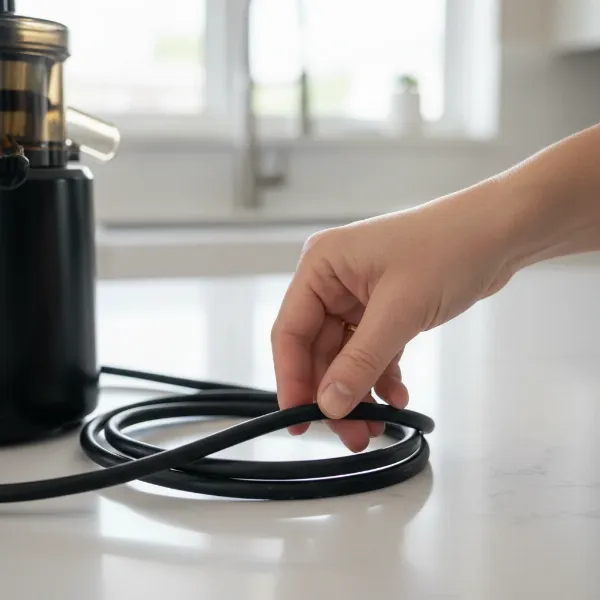 Close-up of a hand inspecting a juicer's power cord for fraying and damage, emphasizing safety.
Conclusion
A frayed power cord on your juicer is a safety concern that should never be ignored. While minor, superficial damage might be temporarily addressed with caution, the safest course of action for any significant fraying or exposed wires is always replacement of the cord or, if necessary, the entire appliance. Prioritize safety by ensuring the juicer is unplugged before any inspection or work, using the correct tools, and following proper electrical guidelines.
Remember, a well-maintained power cord ensures your juicer operates efficiently and safely for years to come. Do you regularly check your appliance cords for signs of wear? Taking a few moments for inspection can make all the difference.
Frequently Asked Questions
Can I just use any replacement cord for my juicer?
Table is empty.No, you should always aim to use a replacement cord that matches the original specifications for gauge (thickness), length, and type (e.g., two-prong or three-prong grounded). Using an undersized cord can lead to overheating and fire hazards.
What are the signs that my juicer’s power cord needs immediate attention?
Look for exposed metal wires, deep cuts, charred or melted insulation, flickering power, or the cord feeling unusually warm during operation. Any of these signs indicate an immediate safety risk and require prompt action, ideally replacing the cord or seeking professional help.
Is it always safer to replace the entire juicer if the cord is damaged?
Not necessarily. If the damage is confined to the power cord itself and the cord can be safely replaced (either by replacing the plug or the entire cord assembly), the juicer may still be perfectly functional. However, if the damage extends into the juicer’s housing, or if you’re uncomfortable with electrical work, professional assessment or full replacement is advisable.
How can I prevent my pet from chewing on my juicer’s power cord?
Keep appliance cords out of reach or utilize cord protectors (such as bitter-tasting sprays or rigid cable conduits) to deter chewing. Consistent training and providing appropriate chew toys can also help redirect your pet’s attention away from electrical cords.
What should I do if my juicer’s power cord sparks?
If your juicer’s power cord sparks, immediately unplug the appliance (if safe to do so) or switch off the circuit breaker for that outlet. Do not use the juicer again until the cord has been professionally inspected and repaired or replaced. A sparking cord is a serious fire and shock hazard.